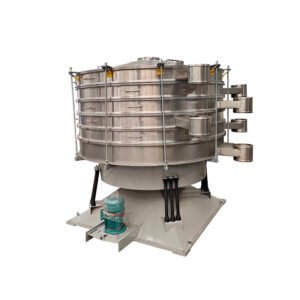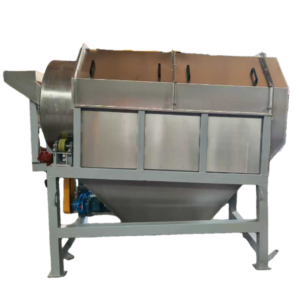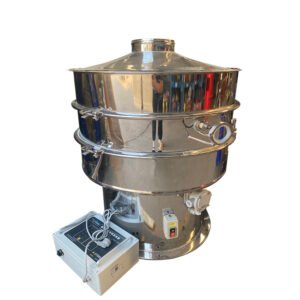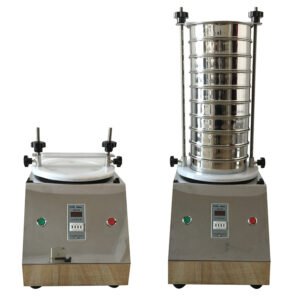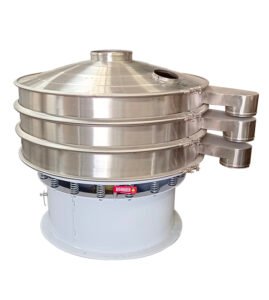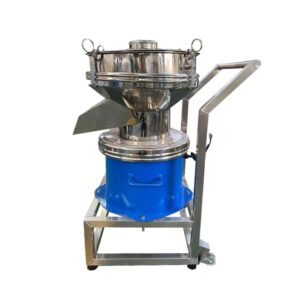
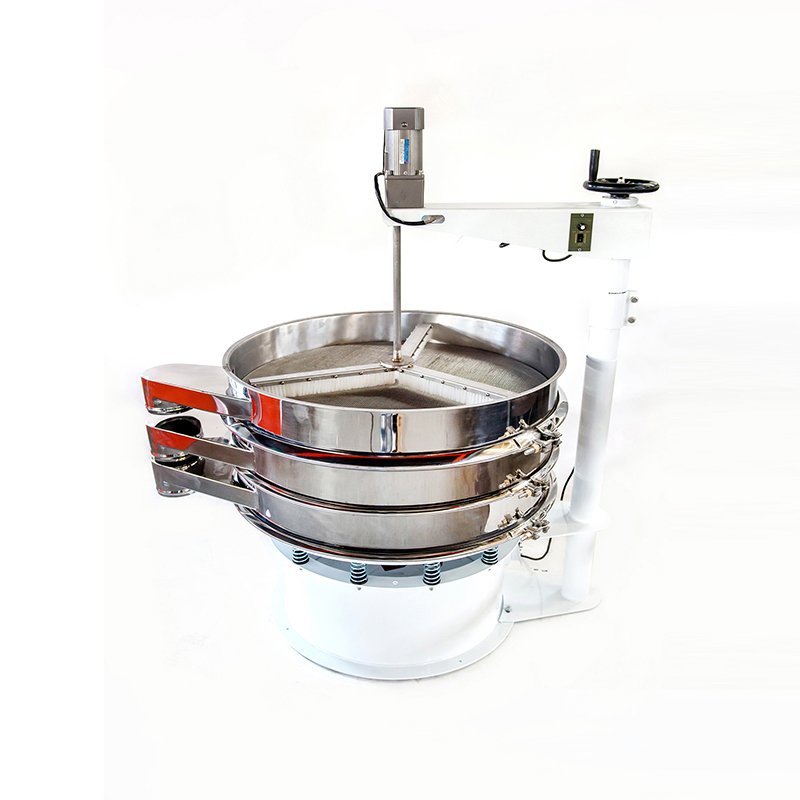
The brush-type vibrating screen is a high-efficiency screening device that combines mechanical vibration with brush cleaning functions. It is primarily used to solve the clogging problem of traditional vibrating screens when screening sticky, easily agglomerated, or high-moisture materials. Its core design uses a vibrating motor to drive the screen box to generate high-frequency vibration, while simultaneously equipped with a rotating brush system to clean the screen in real time, ensuring screening efficiency and continuity.
■ Working Principle and Structural Design
Dual Power Synergistic Effect: The brush-type vibrating screen uses a vibrating motor to generate excitation force, causing the screen surface to move in three dimensions (horizontal, vertical, and inclined). Material is thrown up and jumps forward on the screen, completing particle size classification. At the same time, nylon or stainless steel brushes installed below the screen are driven to rotate by an independent motor, cleaning the screen in reverse at a speed of tens of revolutions per minute, effectively removing adhered particles. This “vibration + brushing” linkage mechanism significantly reduces the probability of screen clogging, making it particularly suitable for screening easily agglomerated materials such as traditional Chinese medicine powder, food additives, and wet metallurgical slurries.
■ Technological Advantages and Industry Applications
1. Breaking Through Traditional Screening Bottlenecks
Compared to ordinary vibrating screens (such as rotary vibrating screens or linear screens), the forced brush vibrating screen can improve screening efficiency by 30%-50%. Taking ceramic glaze production as an example, when using an ordinary vibrating screen, it is necessary to stop the machine and manually clean the screen every 2 hours, while the brush vibrating screen can work continuously for more than 8 hours, increasing production capacity by nearly 3 times. Furthermore, its screening accuracy can reach 500 mesh (approximately 25 microns), and the amplitude (usually 2-5 mm) and brush speed can be adjusted by a frequency converter to adapt to different material characteristics.
2. Typical Application Scenarios
– Chemical Industry: Screening materials that are easily electrostatically adsorbed, such as titanium dioxide and resin particles; the brush can eliminate electrostatic agglomeration.
– Food Processing: Processing high-moisture raw materials such as sugar powder and starch, avoiding the risk of bacterial growth caused by screen clogging.
– Mining and Metallurgy: In the slurry of graded hydrometallurgical processes, the brush prevents the accumulation of rust or slag.
– Pharmaceutical Industry: FDA-approved models can be used for sieving ultrafine powders of traditional Chinese medicine, ensuring no cross-contamination.
■ Key Selection and Maintenance Points
1. Selection Parameter Considerations
– Material Characteristics: Viscosity, moisture content, corrosiveness (e.g., acidic materials require a 316L stainless steel screen body).
– Processing Capacity Matching Model 1000: Processing capacity is 1-3 tons/hour, suitable for small to medium-scale production lines.
2. Maintenance and Troubleshooting
– Brush Wear Monitoring: It is recommended to check the brush bristle length every 500 working hours; replace if wear exceeds 30%.
– Vibration Anomaly Troubleshooting: Uneven screen body oscillation may be due to aging damping springs or misalignment of the motor eccentric block.
– Cleaning Procedure: For food-grade applications, the screen must be blown clean with compressed air after use.